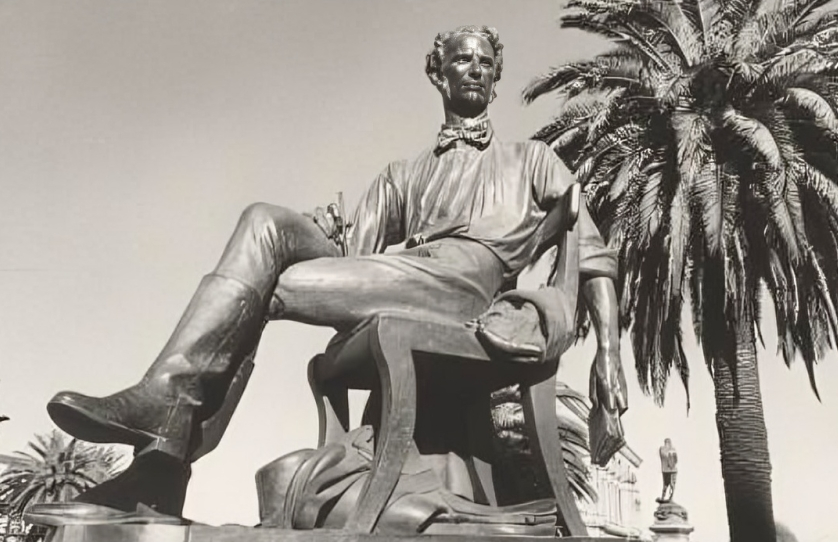
Born in 1833 in the Azores, Adam Lindsay Gordon became recognised—albeit posthumously—as one of Australia’s most distinctive poetic voices of the nineteenth century. During his lifetime, however, his genius was largely overlooked. The son of a British army officer who travelled extensively through India and Australasia before returning to England, Gordon received his education in Cheltenham. Despite his father’s military background and expectations, his own time at school—first in Cheltenham and later at the Royal Military Academy, Woolwich—reflected athletic skill more than scholarly dedication.
Gordon’s life was one of restlessness and contradiction: a man equally drawn to horsemanship and verse, to reckless adventure and metaphysical reflection. His poetry often merges stoic fatalism with an intense sensitivity to nature and human limitation—a blend that came to define colonial Australian romanticism. Doubtful Dreams, one of his reflective and sombre works, encapsulates that recurring tension between aspiration and futility, faith and doubt, action and despair.
Doubtful Dreams by Adam Lindsay Gordon
Aye, snows are rife in December,
And sheaves are in August yet,
And you would have me remember,
And I would rather forget;
In the bloom of the May-day weather,
In the blight of October chill,
We were dreamers of old together, —
As of old, are you dreaming still?
For nothing on earth is sadder
Than the dream that cheated the grasp,
The flower that turned to the adder,
The fruit that changed to the asp;
When the day-spring in darkness closes,
As the sunset fades from the hills,
With the fragrance of perish’d roses,
With the music of parch’d-up rills.
When the sands on the sea-shore nourish
Red clover and yellow corn;
When figs on the thistle flourish,
And grapes grow thick on the thorn;
When the dead branch, blighted and blasted,
Puts forth green leaves in the spring,
Then the dream that life has outlasted
Dead comfort to life may bring.
I have changed the soil and the season,
But whether skies freeze or flame,
The soil they flame on or freeze on
Is changed in little save name;
The loadstone points to the nor’ward,
The river runs to the sea;
And you would have me look forward,
And backward I fain would flee.
I remember the bright spring garlands,
The gold that spangled the green,
And the purple on fairy far lands,
And the white and the red bloom, seen
From the spot where we last lay dreaming
Together — yourself and I —
The soft grass beneath us gleaming,
Above us the great grave sky.
And we spoke thus: “Though we have trodden
Rough paths in our boyish years;
And some with our sweat are sodden,
And some are salt with our tears;
Though we stumble still, walking blindly,
Our paths shall be made all straight;
We are weak, but the heavens are kindly,
The skies are compassionate.”
Is the clime of the old land younger,
Where the young dreams longer are nursed?
With the old insatiable hunger,
With the old unquenchable thirst,
Are you longing, as in the old years
We have longed so often in vain;
Fellow-toilers still, fellow-soldiers,
Though the seas have sundered us twain?
But the young dreams surely have faded!
Young dreams! — old dreams of young days —
Shall the new dream vex us as they did?
Or as things worth censure or praise?
Real toil is ours, real trouble,
Dim dreams of pleasure and pride;
Let the dreams disperse like a bubble,
So the toil like a dream subside.
Vain toil! men better and braver
Rose early and rested late,
Whose burdens than ours were graver,
And sterner than ours their hate.
What fair reward had Achilles?
What rest could Alcides win?
Vain toil! “Consider the lilies,
They toil not neither do spin.”
Nor for mortal toiling nor spinning
Will the matters of mortals mend;
As it was so in the beginning,
It shall be so in the end.
The web that the weavers weave ill
Shall not be woven aright
Till the good is brought forth from evil,
As day is brought forth from night.
Vain dreams! for our fathers cherish’d
High hopes in the days that were;
And these men wonder’d and perish’d,
Nor better than these we fare;
And our due at last is their due,
They fought against odds and fell;
“En avant, les enfants perdus!”
We fight against odds as well.
The skies! Will the great skies care for
Our footsteps, straighten our path,
Or strengthen our weakness? Wherefore?
We have rather incurr’d their wrath;
When against the Captain of Hazor
The stars in their courses fought,
Did the skies shed merciful rays, or
With love was the sunshine fraught?
Can they favour man? Can they wrong man?
The unapproachable skies?
Though these gave strength to the strong man,
And wisdom gave to the wise;
When strength is turn’d to derision,
And wisdom brought to dismay,
Shall we wake from a troubled vision,
Or rest from a toilsome day?
Nay! I cannot tell. Peradventure
Our very toil is a dream,
And the works that we praise or censure,
It may be, they only seem.
If so, I would fain awaken,
Or sleep more soundly than so,
Or by dreamless sleep overtaken,
The dream I would fain forego.
For the great things of earth are small things,
The longest life is a span,
And there is an end to all things,
A season to every man,
Whose glory is dust and ashes,
Whose spirit is but a spark,
That out from the darkness flashes,
And flickers out in the dark.
We remember the pangs that wrung us
When some went down to the pit,
Who faded as leaves among us,
Who flitted as shadows flit;
What visions under the stone lie?
What dreams in the shroud sleep dwell?
For we saw the earth pit only,
And we heard only the knell.
We know not whether they slumber
Who waken on earth no more,
As the stars of the heights in number,
As sands on the deep sea-shore.
Shall stiffness bind them, and starkness
Enthral them, by field and flood,
Till “the sun shall be turn’d to darkness,
And the moon shall be turn’d to blood.”
We know not! — worse may enthral men —
“The wages of sin are death”;
And so death passed upon all men,
For sin was born with man’s breath.
Then the labourer spent with sinning,
His hire with his life shall spend;
For it was so in the beginning,
And shall be so in the end.
There is life in the blacken’d ember
While a spark is smouldering yet;
In a dream e’en now I remember
That dream I had lief forget —
I had lief forget, I had e’en lief
That dream with THIS doubt should die —
“IF WE DID THESE THINGS IN THE GREEN LEAF,
WHAT SHALL BE DONE IN THE DRY?”
Critical Discussion
Doubtful Dreams is a poem steeped in melancholy retrospection—a meditation on disillusionment, transience, and the distance between youthful ideals and adult realisation. Gordon’s speaker looks back upon the “dreamers of old,” former companions of hope and rebellion, now separated not only by geography (“Though the seas have sundered us twain”) but by the inevitable erosion of time and faith.
The poem’s cadence and diction reflect the influence of both Romantic and Biblical imagery. Phrases such as “the day-spring in darkness closes” or “the sun shall be turned to darkness” recall scriptural prophecy and moral gravity. Yet Gordon’s tone remains uncertain—poised between lament and acceptance. His recurring interrogatives (“Can they favour man? Can they wrong man?”) underline the existential doubt at his poem’s heart: is human striving meaningful, or merely a dream within a dream?
The verses juxtapose idealism with futility. The repeated evocation of toil—“Vain toil! men better and braver / Rose early and rested late”—echoes the voice of Ecclesiastes: all labour ends in dust and disillusion. Gordon turns classical heroism on its head; Achilles and Alcides (Heracles) receive no lasting rest or reward, reinforcing the poet’s own scepticism toward human glory.
Nevertheless, the poem resists total despair. Its closing refrain—
“If we did these things in the green leaf,
What shall be done in the dry?”
—leans towards a spiritual warning, drawn from the Gospel of Luke. It suggests that the trials and contradictions of earthly life may foreshadow a sterner reckoning still to come.
Themes and Style
Mortality and Ephemerality: Gordon repeatedly emphasises life’s brevity—“The longest life is a span, / And there is an end to all things.” The inevitability of decay lends the poem its elegiac tone.
Dream versus Reality: The title itself embodies the irony of human aspiration. Dreams, though noble, are transient and untrustworthy. What once fuelled youthful faith now appears “the dream that cheated the grasp.”
Moral and Philosophical Pessimism: The poet’s reflections move beyond doubt into metaphysical questioning. The universe, he seems to suggest, may be indifferent to human endeavour.
Gordon’s verse, though lyrical, remains tempered by stoic restraint. His rhythm and rhyme recall the classical balance of Tennyson or Arnold, yet his colonial context lends a rougher, more visceral realism. The language—alternating between tactile imagery (“fragrance of perish’d roses”) and moral aphorism—creates the impression of a man struggling to reconcile conscience with circumstance.