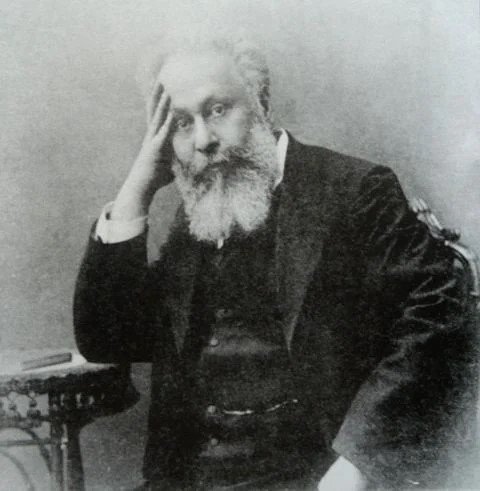
The celebrated Georgian poet Akaki Tsereteli (1840–1915) was one of the foremost literary figures of nineteenth-century Georgia. Born into a distinguished aristocratic family, he was entitled to bear the title Prince before his name. Yet, for all his aristocratic heritage, Tsereteli’s heart and pen belonged to the people.
He was not only a renowned poet and lyricist, but also a pioneer of education and an influential voice in Georgia’s growing national liberation movement. Through his prose and poetry, he sought to awaken a sense of patriotism, dignity, and resilience within his compatriots. Among his many lyrical works, none has resonated so widely or endured so deeply as Suliko — a poem that captures both personal grief and transcendent love.
Suliko by Akaki Tsereteli
“In vain I sought my loved one’s grave;
Despair plunged me in deepest woe.
Overwhelmed with bursting sobs I cried:
O where are you, my Suliko?”
In solitude upon a bush
A rose In loveliness did grow;
With downcast eyes I softly asked:
“Isn’t that you, O Suliko?”
The flower trembled in assent
As low it bent its lovely bead;
Upon its blushing cheek there shone
Tears that the morning skies had shed.
Midst rustling leaves a nightingale
Was singing to the rose below;
I hailed the bird and gently asked:
“Isn’t that you, O Suliko?”
The songster fluttered nearer to
The rose, and on it pressed a kiss;
Disburdening its soul in song
That breathed of ecstasy and bliss.
A twinkling star shed shimmering light
Upon me in a silver glow;
I turned to it, and whispered low;
“Isn’t that you, O Suliko?”
As I gazed on the star that shone
In light that glimmered bright and clear
A gentle breeze came passing by
And stopped to whisper in my ear.
“What thou dost seek is found at last.
Henceforth your heart but calm will know;
The night will bring you sweet repose.
And lay will chase away your woe.
“Your Suliko was changed into
A nightingale, a star and rose;
Your souls that true love bound as one
To realms divine in heavens rose.”
I seek no more my loved one’s grave,
No more do I in sorrow weep,
The world no longer hears me sigh;
Nor sees me drowned in anguish deep.
None can express the bliss I feel
To hear the nightingale from far,
To breathe the essence of the rose;
And gaze upon the shining star.
My bosom throbs once more in joy;
No more am I oppressed by woe;
I seek no tomb, for now I see
Thy dwellings three, my Suliko!”

Background of “Suliko”
Suliko (Georgian for “soul” or “sweetheart”) is Akaki Tsereteli’s most famous poem, written in 1895. Soon after its composition, it was set to music by composer Varinka Tsereteli (no relation to Akaki), becoming one of the most beloved Georgian songs of all time. For generations, Suliko has been regarded as something of a national folk elegy, sung in both joyful and mournful tones — a hymn of devotion that bridges the earthly and the eternal.
The song became especially symbolic in the Soviet era, when Joseph Stalin reputedly listed it among his favourite melodies. Yet, beyond politics, Suliko remains cherished across Georgia and much of the Caucasus as an expression of profound, undying love.
The Poem
“In vain I sought my loved one’s grave;
Despair plunged me in deepest woe.
Overwhelmed with bursting sobs I cried:
O where are you, my Suliko?”
Thus begins the poem, with the narrator wandering in grief, desperately searching for the grave of his beloved Suliko. The tone, steeped in lamentation, soon transforms into one of mystical revelation.
As he roams through nature’s quiet splendour, the poet beholds a rose, a nightingale, and a star—each seeming to embody some essence of his lost love. In the rustling breeze, in the bird’s song, and in the flower’s trembling beauty, he perceives the spirit of Suliko.
This imagery culminates in the poem’s haunting resolution: love transcends death. The beloved has been transfigured—
“Your Suliko was changed into / A nightingale, a star, and rose.”
Through these symbols, Tsereteli captures an unforgettable harmony between nature and emotion, sorrow and serenity, mortality and eternity.
Themes and Interpretation
At its heart, Suliko is a meditation on love’s immortality. The lyrical speaker’s quest for his beloved’s resting place becomes a spiritual journey—from despair to enlightenment, from human grief to divine consolation.
Nature’s sacred voice plays a central role here. The rose that blushes, the nightingale that sings, the star that glimmers above—all become metaphors for an enduring presence that transcends physical death. The message is gently hopeful: love, though separated by mortality, continues in other forms, eternal and omnipresent.
Structurally, the poem’s simplicity—its regular rhythm and tender refrain—recalls the cadence of Georgian folk verse, making it easy to adapt into song. The repetition of “Isn’t that you, O Suliko?” functions as both lament and invocation, lending the poem its hypnotic, prayer-like quality.
Cultural Legacy
Few literary works have achieved the influence that Suliko enjoys in Georgia. It is sung at weddings, funerals, and national celebrations alike, its melody woven into the country’s cultural identity. Every Georgian, it is said, knows the tune—passed down through generations, sung in harmony or soft lament by families around the dinner table or in times of separation.
Translated into multiple languages, Suliko also introduced Western audiences to the lyrical grace of Georgian poetry in the late nineteenth and early twentieth centuries.