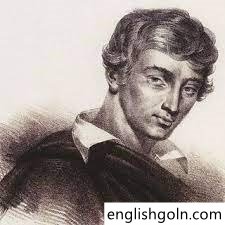
The Three Brothers Budrys, Adam Bernard Mickiewicz was born in December 1798 into a family of minor Polish nobility known as the szlachta. Their status allowed them to bear the hereditary Poraj coat of arms. The family lived on a grand estate in Zaosie, near Navahrudak. This was within the Russian Empire on the outskirts of Lithuania. Its modern day location is Belarus. Just to illustrate the political instability of this area, it had previously been a part of the Grand Duchy of Lithuania, the Polish-Lithuanian Commonwealth and then Belarus. Much of Mickiewicz’s writing had Belarusian and Lithuanian folklore influences.

He had a good education and studied at the Imperial University of Vilnius. It was here that his political activities began when he and a group of friends formed a secret society called the Philomaths. Their aims were clear and unequivocal – total independence from the Russian Empire. On graduation he became a teacher at a secondary school in Kaunas but he continued with his membership of the Philomaths and, in 1823, the authorities arrested him and he was banished to central Russia as a punishment.
The Three Brothers Budrys by Adam Mickiewicz
The Three Brothers Budrys
He has summoned his lusty sons three.
“Your chargers stand idle, now saddle and bridle
And out with your broadswords,” quoth he.”For with trumpets’ loud braying in Wilno they’re saying
That our crmies set forth to three goals;
And Scirgiell – our neighbours the Poles,”Stout of heart and of hand, go, fight for your land
With the gods of your fathers to guide you;
Though I mount not this year, yet my rede ye shall hear:

One shall follow ‘neath Olgierd’s device:
There are sables’ black tails there are silvery veils,
There are coins shining brightly like ice,”With Kiejstut’s hordes ample the next son shall trample
That dog’s breed, the Knights of the Cross;
And brocades al a marvellous gloss,”In the barren, stripped land beyond Niemen’s wide strand
Where goes Skirgiell, the third son shall ride;
Only buckler and sword will he get as reward,
But from there he shall bring him his bride.”For ’tis Poland the world over that’s the land lor a lover:
All the maids are like kittens at play;
And their eyes – like the star-shine are they!Fifty years are now sped and my bride is long dead,
The bright Pole I brought home from a raid:
And yet still when I stand and gaze out toward that land,
I remenber the face of that maid.”So he ends and they turn, he has blessed them their journey:
Fall and winter both pass, never word comes, alas,
And old Budrys had thought his sons dead.
Through the high-piling drift comes a youth riding swift,
‘Neath his mantle rich booty doth hide:
“Ah, a Novgorod kettle full of silver-bright metal!”
– “Nay, my father, a Polish bride!”
Through the high-piling drift comes a youth riding swill,
‘Neath his mantle rich booty doth hide:
“Ah, amber, my son, in the German land won'”
– “Nay, my father, a Polish bride!”
Through the high-piling drift rides the third. Ah, his gift,
‘Tis the pride of the west and the east!
But while yet it is hidden, old Budrys has bidden
His guests to the third wedding feast.